


Dear Investors,
The Triffin Dilemma, a concept first introduced in the mid-20th century, remains a critical economic challenge for the United States today.
As the issuer of the world’s primary reserve currency, the U.S. faces a unique paradox: the need to provide global liquidity while maintaining domestic economic stability.
Understanding this dilemma is crucial to navigating its implications for global markets and the U.S. economy. 🌍💵
Let’s explore how the Triffin Dilemma manifests in modern times and its impact on economic growth, trade, and monetary policy. ⏳
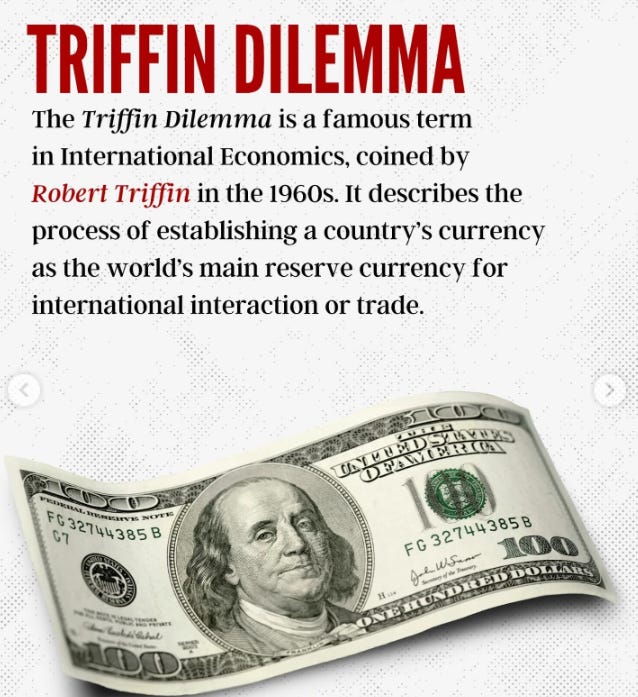
What Is the Triffin Dilemma?
The Triffin Dilemma arises when a national currency serves as the global reserve currency.
To meet international demand, the issuing country must run persistent trade deficits, leading to long-term economic imbalances.
For the U.S., this means balancing global liquidity needs with domestic fiscal and monetary priorities. 🌐📉
Impact on the U.S. Economy
The U.S. has run consistent trade deficits for decades, importing more than it exports to provide dollars to the world.
In 2022, the U.S. trade deficit reached a record $948 billion, highlighting the scale of this imbalance.
While these deficits support global liquidity, they weigh on domestic manufacturing and employment. 📦📉
The dollar’s status as the global reserve currency drives its demand, keeping it stronger than it might otherwise be.
While a strong dollar benefits consumers through cheaper imports, it hurts exporters and can lead to slower economic growth.
This was evident during the 2022 dollar surge, which reduced the competitiveness of U.S. goods abroad. 💵📊
As the global reserve currency issuer, the Federal Reserve must consider international ripple effects when setting monetary policy.
Rate hikes aimed at controlling domestic inflation can trigger capital outflows and currency crises in emerging markets reliant on dollar-denominated debt. 🌍📈
Global Implications
The Triffin Dilemma also affects global markets.
When the U.S. tightens monetary policy, global dollar liquidity shrinks, causing stress in financial markets.
Efforts by nations like China and Russia to promote alternatives to the dollar, such as the yuan or BRICS currency initiatives, highlight growing concerns over the dollar’s dominance. 🌏
Visions of Tomorrow
As global trade evolves, the Triffin Dilemma will remain a central challenge for the U.S. and the global economy.
Central banks worldwide are gradually increasing their holdings of non-dollar assets, including gold and euros.
In 2022, the dollar’s share of global reserves fell to 59%, its lowest in 25 years. 📉
The rise of central bank digital currencies (CBDCs) could challenge the dollar’s dominance by offering new avenues for cross-border payments.
Regional trade agreements and de-dollarization efforts may reduce global reliance on the dollar over time. 🌐📊
How I’m Positioning for Triffin Dilemma Trends
To navigate the macroeconomic effects of the Triffin Dilemma, I focus on strategies that balance global exposure and domestic resilience.
Investing in commodities and gold hedges against dollar volatility and global liquidity shifts, ensuring stability.
Allocating to markets diversifying away from the dollar provides exposure to growth opportunities in alternative trade blocs. 🌍💼
Holding non-dollar currencies and assets mitigates risks tied to dollar fluctuations.
Monitoring geopolitical developments and monetary policies helps anticipate shifts in global reserve currency dynamics and position effectively for both risks and opportunities. 📊🚀
Bonus Lesson to Remember
The Triffin Dilemma underscores the complexities of global economic leadership.
By understanding its dynamics, investors can better navigate the challenges and opportunities tied to the dollar’s role. 🌍📉
For me, tracking this dilemma is essential for long-term portfolio stability.