


Dear Investors,
Every so often, there are weeks when the markets feel like they are whispering a story – and this was one of them.
These are the moments when data stops being just numbers and becomes a narrative.
When liquidity, positioning, valuations, and sentiment combine to form a picture that is as much psychological as it is financial.
I spent this week piecing together signals, not only from US equities and currencies but also from Japan’s bond markets, global investor flows, and the underlying tone of risk appetite.
When you zoom out and connect these dots, you begin to see a powerful story emerge – one that hints at both danger and opportunity.
This isn’t just about what’s happening today; it’s about the forces shaping the next chapter in global markets.
A Dollar at a Turning Point
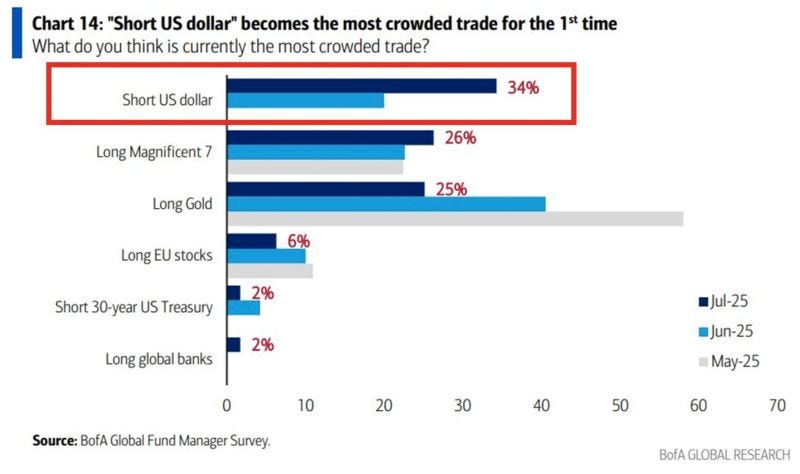
The trade against the US dollar has become one of the most crowded in history, and I can’t help but revisit the lessons from the past.
In 2009 and 2017, when positioning was this one-sided, the dollar rebounded sharply by 4-6% within just a quarter, catching many off guard.
Now we’re watching Japan alter the script.
Its 10-year JGB yield has climbed to 1.6%, a 17-year high, shifting the Japan-US 30-year yield differential in ways that could reshape currency markets.
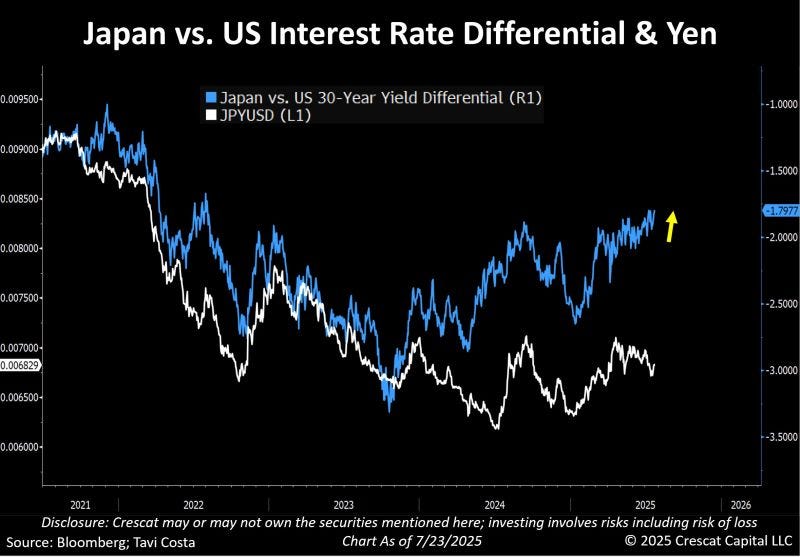
I remember 2012-2014, when similar shifts pushed the yen 12% stronger against the dollar, forcing investors to rethink carry trades and reprice risk.
Japan’s $550B capital commitment adds yet another layer.
While the timeline for deployment remains vague, a large portion will likely find its way into US Treasuries.
This not only influences yields but also alters the demand-supply dynamics underpinning the dollar’s relative strength.
For those of us watching closely, this doesn’t feel like an isolated move – it feels like a calculated step in a broader strategy that could realign global capital flows.
When Liquidity Meets Excess
The US money supply has surged past $22T, an all-time record.
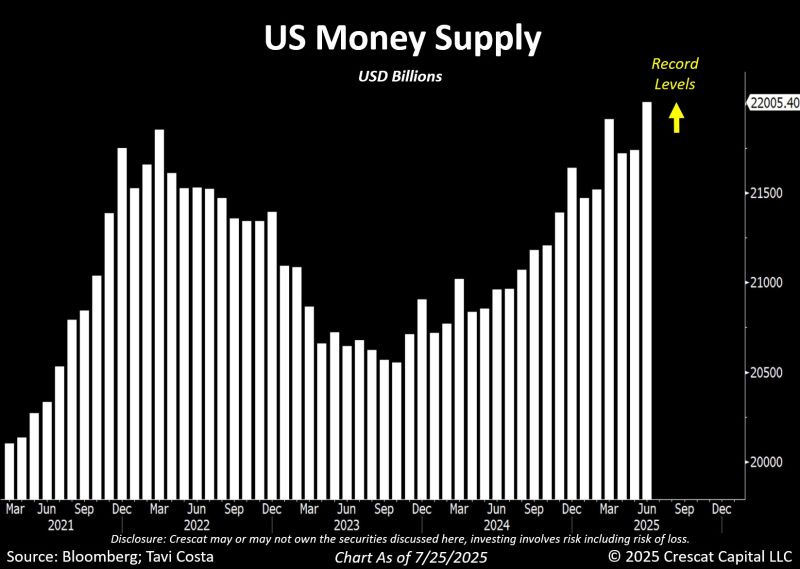
It’s tempting to see this as an unqualified positive – after all, in 2020, similar liquidity waves fueled 18-22% S&P rallies within 12 months.
But when I pair that with a Shiller P/E of 38.8x, higher than 96% of all historical readings, the story shifts.
This takes me back to the early 2000s.
I remember how markets then were buoyed by euphoria, convinced that the rules had changed, only to see the S&P plummet 49% over two years when reality finally set in.
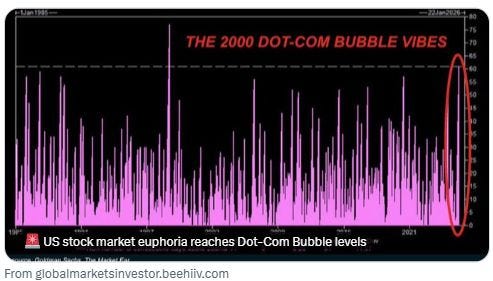
The uncomfortable truth is that liquidity doesn’t erase gravity; it only delays it.
What we are seeing now is a dangerous mix of optimism and complacency, with valuations stretched to levels that history has shown to be unsustainable for long.
The longer this persists, the sharper the eventual reversion is likely to be.
Tech’s Towering Shadow
Technology has been the engine of market growth for over a decade, but its dominance has reached levels that demand scrutiny.
Officially, tech makes up 33.6% of the S&P 500.
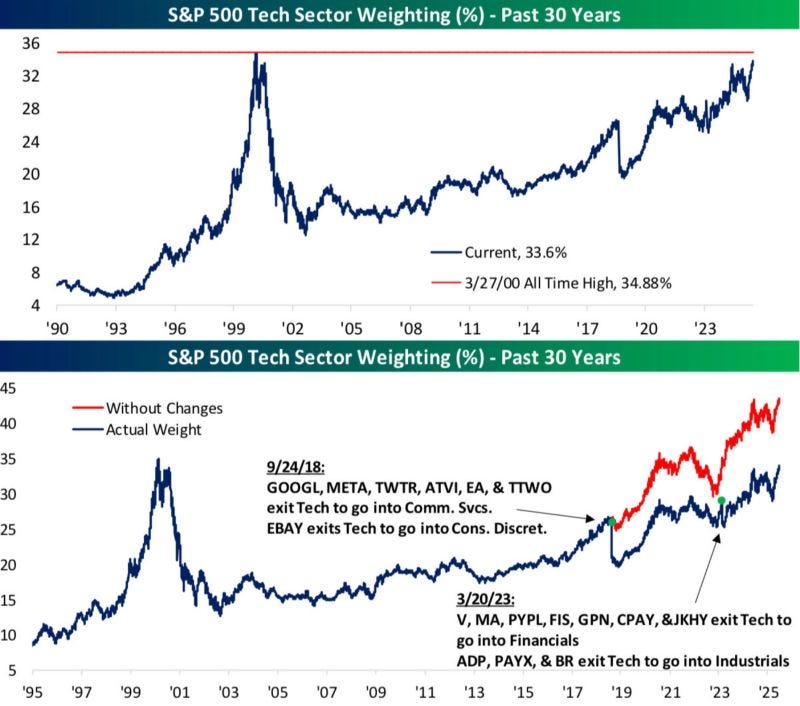
Yet when we adjust for companies like Visa, Mastercard, and Meta that were reclassified in recent years, its true share balloons to nearly 45%.
That’s more than the Dot-Com peak of 34.9%.
Back in 2000, after that peak, tech underperformed the broader index by an astonishing -58% over three years, leaving investors humbled.
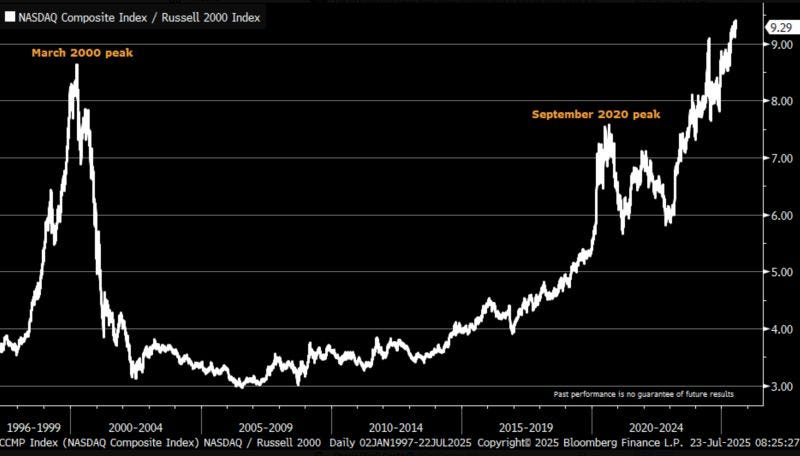
Today, we are witnessing a similar concentration risk – the kind that makes the market vulnerable to even minor shocks in a single sector.
It’s impossible not to admire the innovation fueling this growth, but it’s equally impossible to ignore how exposed we’ve become to any stumble in the tech narrative.
As I scan across these signals, I can’t shake the feeling that we are standing at a major inflection point.
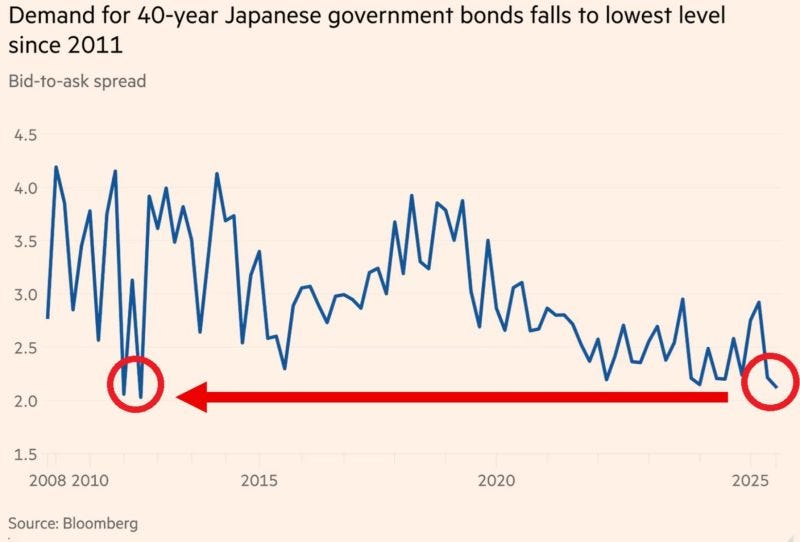
Japanese bonds are flashing warnings, with 40-year demand collapsing to its weakest level since 2011, when yields jumped 40bps in just six months.
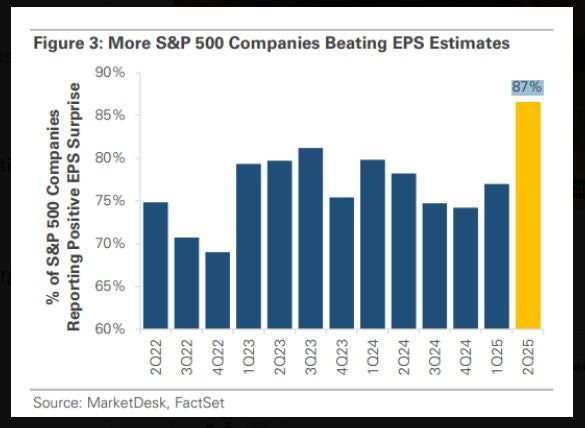
Meanwhile, 87% of S&P companies are beating earnings estimates, a figure that historically added 8% to the index over the following six months.
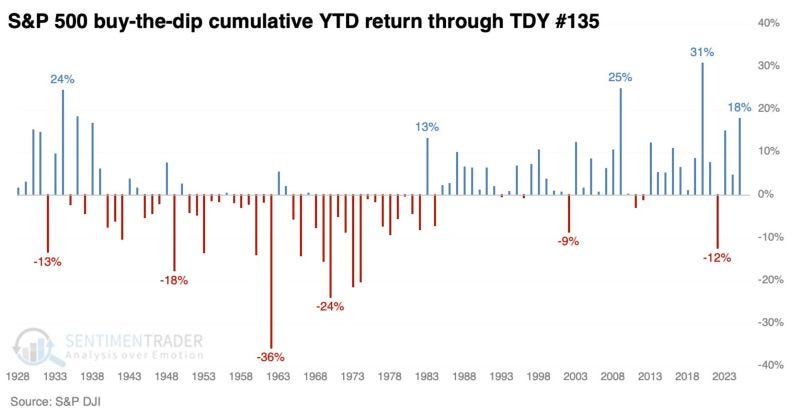
The buy-the-dip mentality is alive and well, delivering +18% YTD – the fourth-strongest result since 1948.
Yet these are precisely the types of conditions where confidence can morph into complacency, leaving markets exposed to a shock that rewrites the narrative overnight.
If Japan keeps nudging rates upward, USD/JPY could easily slide toward 140-145.
If S&P valuations normalize to their 10-year average of 24x, we may be staring at a 20-25% correction, a painful but historically consistent adjustment.
And if the crowded short-dollar trade unwinds, a 5-7% DXY rebound could unfold rapidly, punishing those who assumed the trend was one-way.
Liquidity is everywhere. Optimism is overflowing.
Valuations are stretched beyond historical comfort zones.
These are the moments when even small shocks can create outsized reactions – and when prepared, disciplined investors uncover the best opportunities in years.
This isn’t just about weathering the storm; it’s about positioning yourself to thrive in it.