
Dear Investors,
This lesson isn’t about a new strategy or some secret market insight.
It’s about a way of thinking – one that the best macro investors, policymakers, and innovators rely on every day.
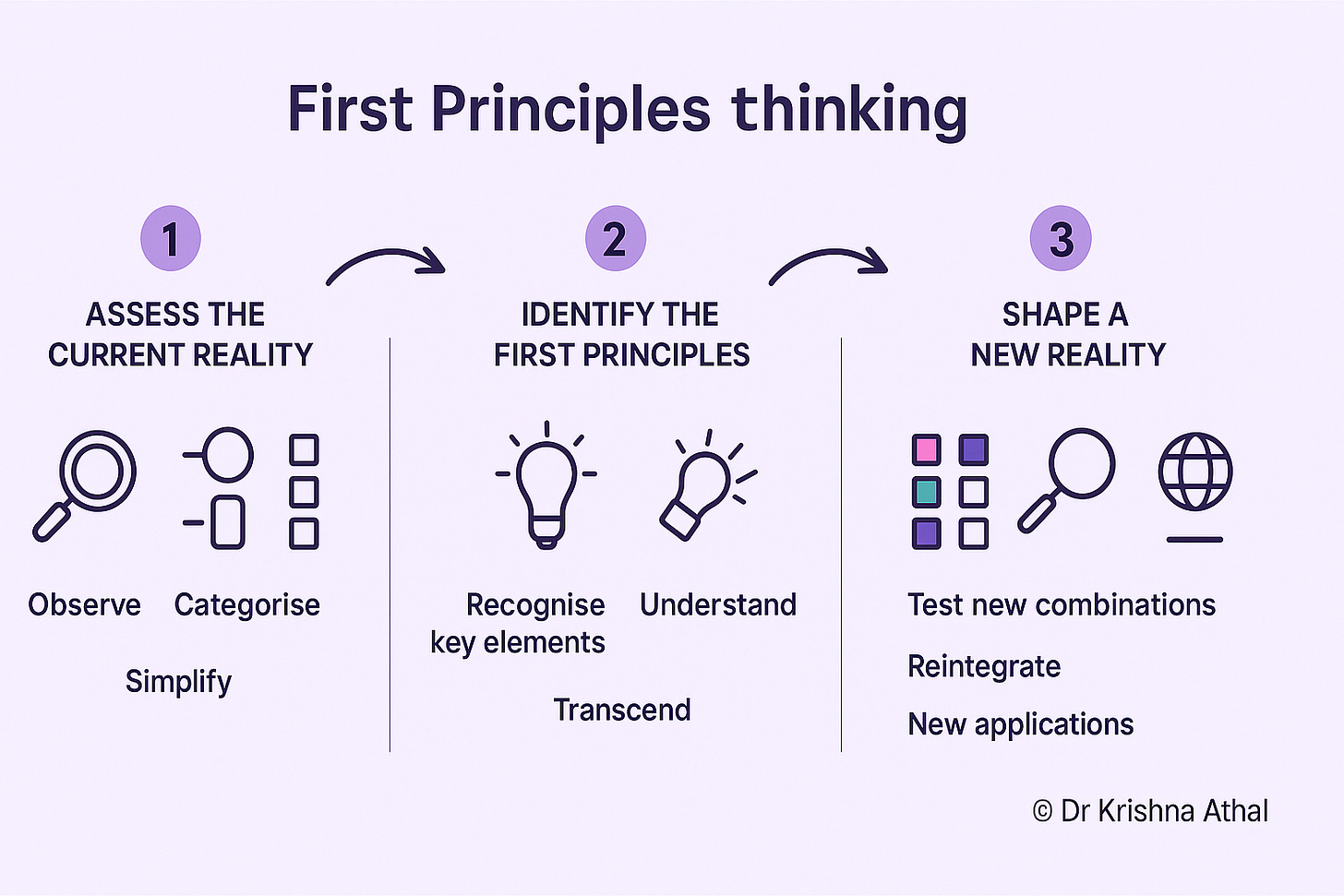
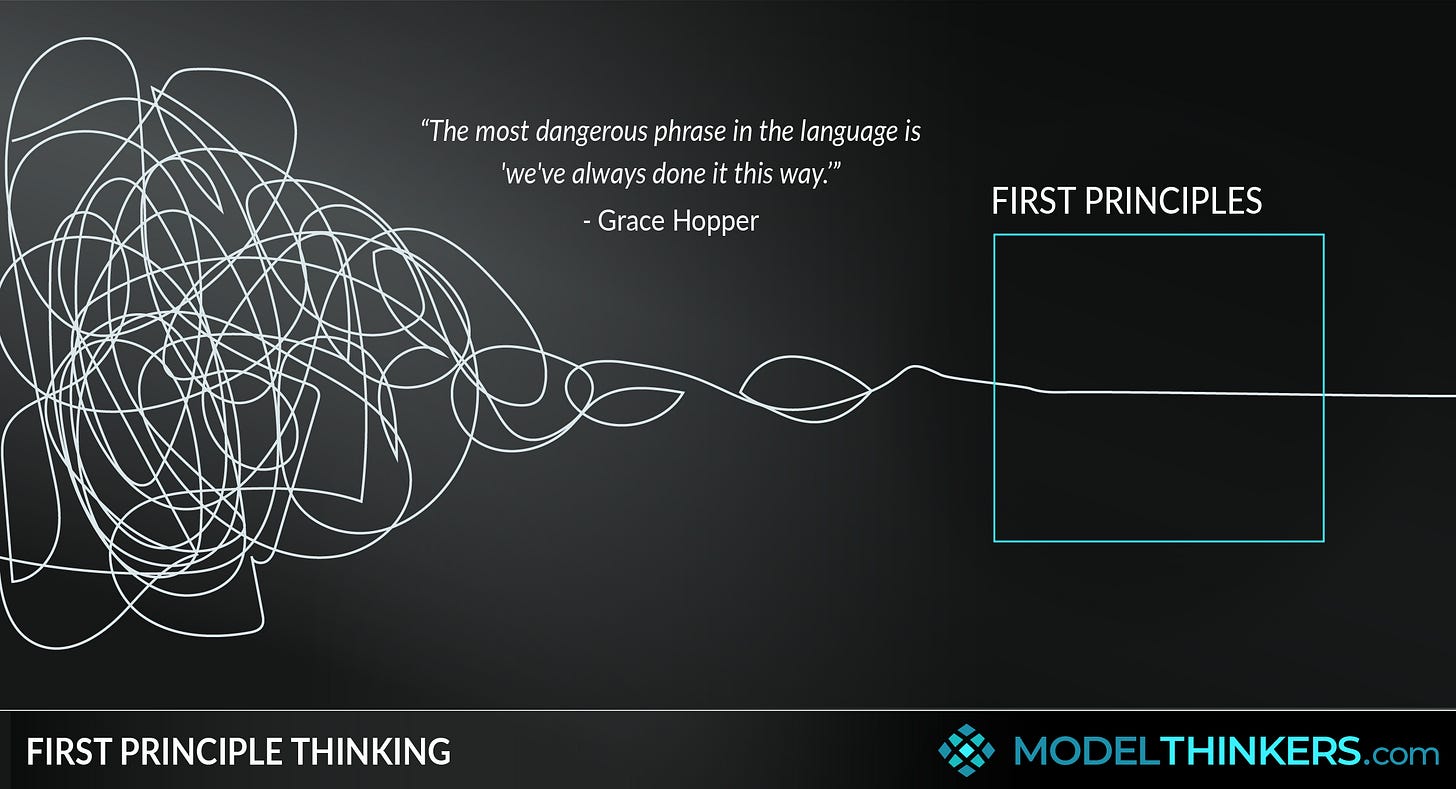
First principles thinking is the discipline of breaking down complex systems to their raw fundamentals.
It’s the practice of stripping away all assumptions and rebuilding from the ground up – with logic, not legacy.
If you’ve ever felt overwhelmed by the noise of economic data, conflicting narratives, or volatile market reactions, this mental model might be the anchor you’ve been looking for.
The Hidden Engine Behind Clarity
I first encountered the concept of first principles thinking not through a finance book, but while reading about Elon Musk.
He once asked: “Why do rockets cost so much?” Instead of accepting the industry’s standard pricing, he broke down a rocket into its base materials – aluminum, titanium, carbon fiber – and realized that the raw inputs were only 2% of the price tag.
That question, asked from first principles, gave birth to SpaceX and reduced launch costs by more than 90%.
That idea hit me like lightning.
What if we applied the same reasoning to economics? To market strategy?
When I studied the 2008 financial crisis, I saw people pointing fingers in every direction – subprime mortgages, greedy bankers, lax regulation.
But none of these were root causes.
When I broke it down to first principles, I saw something more fundamental: if debt grows faster than income for long enough, defaults become inevitable.
Everything else – asset bubbles, credit spreads, collapses – is just a delayed consequence.
That insight isn’t just historical. It repeats.
I used the same logic when analyzing Greece in 2012, China’s corporate leverage in 2015, and Turkey’s currency crisis in 2018.
Different geographies, same foundational cracks. That’s the power of thinking from zero.
From Market Noise to Market Structure
Let’s be honest: most investors don’t think from first principles.
They inherit opinions. They read headlines. They react emotionally.
They build views on top of what others believe, layering sentiment upon sentiment until their foundation rests on assumptions they’ve never even questioned.
It happens with inflation. It happens with interest rates. It happens every day.
In the past two years, I watched the market flip back and forth. Inflation is dead, then inflation is back.
The Fed is dovish, then hawkish, then maybe pausing, then maybe hiking again.
People try to trade this noise, but I ask a simpler question: what creates sustainable inflation?
I don’t mean in the moment, I mean structurally.
And the answers are never found in headlines – they’re found in flows, in fiscal behavior, in demographic pressures, and in long-term wage trends.
I remember in early 2022, when rate hikes began, many panicked. Some expected an immediate recession. But I returned to first principles.
I asked: what happens when nominal rates rise but inflation expectations stay sticky?
The answer is that real yields adjust slowly. Which means liquidity doesn’t vanish overnight.
Which explained why the S&P 500 held up for months before tightening truly started to bite.
Later, during the SVB collapse in 2023, I wasn’t reacting to social media panic. I was asking: is this a systemic liquidity threat or an isolated event?
First principles told me that, due to the Fed’s tools, including the discount window and emergency facilities, the situation would likely be contained. And it was.
It’s not about predicting the news. It’s about understanding the machine beneath the surface.
How I Learned to Think from Scratch
Before I embraced this mindset, I used to read everything. I wanted to be on top of every macro report, every Fed statement, every geopolitical update.
I felt informed, but I wasn’t thinking independently. I was reacting.
That changed when I started building investment views like an engineer – starting not from what I was told, but from what I could verify.
I asked simple but powerful questions: What drives rates higher? What causes yield curve inversions? Why does central bank credibility matter?
Suddenly, I wasn’t riding the waves – I was seeing the tide.
For example, when thinking about whether to invest in emerging markets, I don’t start by reading analyst opinions.
I ask: are the fundamentals – like current account balances, reserve adequacy, political risk premiums – strong or deteriorating?
Is the real yield high enough to compensate for the risk? Is the capital flow story improving or declining?
From that base, I start to build.
This is how I now filter every macro event: not as a reaction, but as a question. Not from the surface, but from the structure.
What This All Means
If there’s one mindset I hope you adopt from today’s lesson, it’s this: don’t inherit your thinking. Rebuild it.
The world is full of noise, but only a few people pause long enough to ask, What is true here? What is absolutely necessary? What’s built on sand?
When you begin to think from first principles, you stop fearing the complexity of markets – and you start mastering it. You see through volatility.
You understand how the system functions. And most importantly, you stop outsourcing your decision-making to the crowd.
As we move forward in this Macro Mindset journey, everything we’ll cover – from diversification to risk-taking, from monetary regimes to market psychology – will be stronger if you keep this foundation beneath it.
So today, start small.
Take a macro issue – interest rates, inflation, housing, energy – and instead of repeating what you’ve heard, try to reduce it to first principles.
What are the drivers? What are the constraints? What happens next if nothing changes?
Next week, we’ll explore Ray Dalio’s “Holy Grail” of diversification – and why most investors misunderstand what true diversification really is.