


Dear Investors,
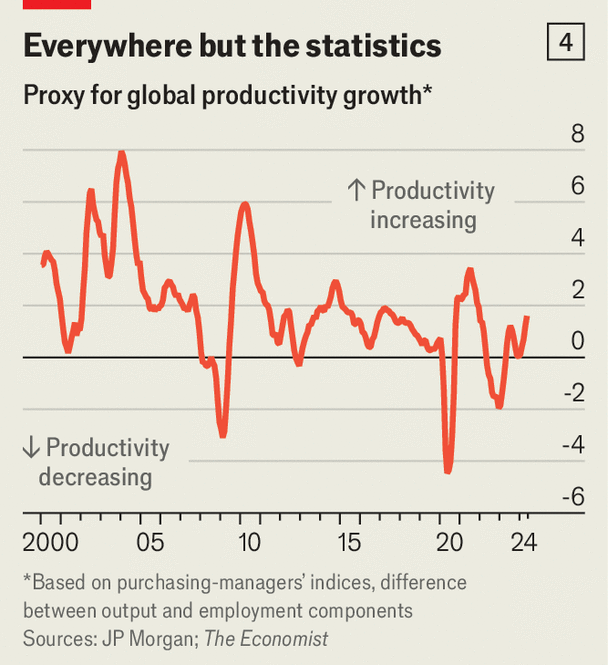
The rapid advancements in artificial intelligence (AI) are ushering in a new era of productivity growth, with significant implications for global economies.
By automating processes, enhancing decision-making, and creating new industries, AI has the potential to reshape GDP growth, inflation dynamics, and labor markets.
Understanding these macro effects can help investors and businesses adapt to the evolving landscape. 🤖📊
Let’s explore how AI-driven productivity gains are transforming the global economy and what it means for the future. ⏳
AI and GDP Growth
AI’s ability to automate repetitive tasks and optimize operations is expected to boost GDP significantly over the coming decades.
A McKinsey report estimates that AI could contribute up to $13 trillion to the global economy by 2030, increasing annual GDP growth by an additional 1.2%. 🌍📈
Key sectors like healthcare, finance, and manufacturing stand to benefit the most from AI adoption.
By enabling faster drug development, optimizing supply chains, and reducing operational inefficiencies, AI is unlocking new avenues for growth.
Inflation Dynamics in an AI-Driven Economy
The deflationary effects of AI are another critical consideration.
By reducing production costs and improving efficiency, AI could help moderate inflationary pressures, especially in labor-intensive industries.
AI-enabled robotics are reducing production costs by up to 20-30% in manufacturing, making goods more affordable.
AI diagnostics and telemedicine are driving down healthcare costs, improving access without significantly increasing prices.
However, the adoption of AI may also create inflationary pressures in the short term, particularly as firms invest heavily in technology infrastructure and training.
Balancing these forces will shape future inflation trends. 📊
Employment and Labor Markets
AI’s impact on employment is a double-edged sword.
While automation threatens to displace certain roles, it also creates opportunities in tech development, data analysis, and AI maintenance.
Roles in routine-heavy sectors like logistics and customer service are most at risk, but demand for AI specialists, data scientists, and machine learning engineers is surging, with salaries in these fields rising by over 20% annually. 💼
Upskilling and workforce adaptation will be critical to ensuring a smooth transition in labor markets.
Governments and businesses must collaborate to provide training programs and support systems for displaced workers. 🌐📉
Visions of Tomorrow
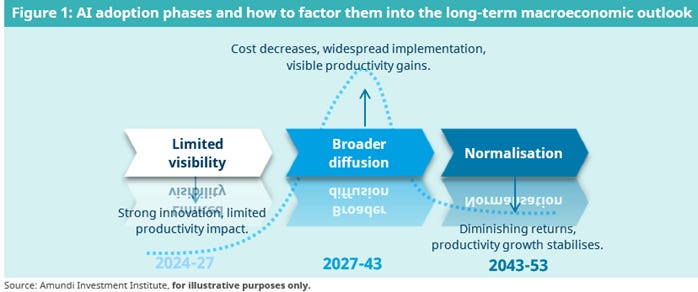
AI-driven productivity gains will likely reshape the global economic landscape in profound ways.
Industries embracing AI early will experience faster growth, while laggards may face competitive pressures.
The benefits of AI could widen the gap between high-skilled and low-skilled workers, necessitating policy interventions.
Moreover, nations investing heavily in AI infrastructure and research, such as the U.S. and China, will dominate the next wave of economic innovation. 🌍🤖
How I’m Positioning for AI’s Macro Effects
To capitalize on AI-driven productivity gains, I focus on sectors and assets poised for growth.
Investing in AI-focused companies and funds offers exposure to cutting-edge advancements.
Supporting firms that enable workforce adaptation, such as edtech platforms, ensures alignment with labor market shifts.
Additionally, allocating to companies building AI infrastructure, like cloud computing and semiconductor firms, provides long-term growth opportunities. 💡
I also monitor government policies and corporate strategies to stay ahead of trends, ensuring a balanced approach to both risks and opportunities.
Bonus Lesson to Remember
AI-driven productivity growth underscores the importance of adaptability in a rapidly changing world.
By aligning with macro trends, investors can position themselves for both stability and innovation. 🌍📉
For me, understanding AI’s macro implications is essential for navigating this transition.