
Dear Investors,
The Dollar Had Become Too Strong to Ignore
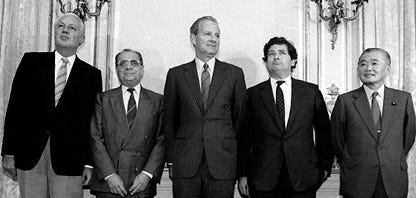
In the mid-1980s, the U.S. dollar was soaring. Not just by a few percentage points – it had appreciated over 50% against major currencies in just five years. And it wasn’t because the U.S. economy was booming. It was a side effect of Volcker’s high interest rate policy, Reagan’s fiscal expansion, and global capital flows seeking safety and yield. But the consequences were real. U.S. exports became painfully uncompetitive. Trade deficits ballooned. Domestic manufacturers struggled to survive. Politically, pressure was mounting. Foreign economies like Japan and West Germany were running huge trade surpluses, and the imbalance was starting to feel like a threat – not just to U.S. industry, but to the global trading order itself. So, in September 1985, at the Plaza Hotel in New York City, something extraordinary happened: the G5 nations agreed to intervene in currency markets to weaken the dollar. This wasn’t a subtle signal. It was a deliberate statement: the exchange rate was no longer just a market outcome – it was a policy tool.
How Markets Reacted When Governments Spoke as One
I’ve always believed that credibility is the real currency in macro. And the Plaza Accord proved it. The announcement was brief – but markets didn’t need more than a headline. Within days, the dollar began to fall. Over the next two years, it would drop more than 40% against the yen and the Deutsche Mark. And here’s what’s remarkable: there was no crisis. No panic. Just coordinated messaging, targeted intervention, and an understanding among the world’s largest economies that global trade imbalances had become too dangerous to ignore. It worked – at least for the United States. The weaker dollar made exports more competitive. U.S. trade deficits began to narrow. Global tensions, for a while, eased. But this wasn’t a free lunch. Because while the U.S. regained some footing, Japan – suddenly facing a sharply stronger yen – was about to walk into something else entirely: an asset bubble of historic proportions.

The Bubble Japan Didn’t See Coming
One of the most haunting lessons of the Plaza Accord is what it unintentionally unleashed in Japan. With the yen surging, Japanese exporters faced declining profits. To counter the slowdown, the Bank of Japan slashed interest rates. Liquidity exploded. And instead of flowing into the real economy, much of it rushed into real estate and stocks. From 1986 to 1989, the Nikkei more than doubled. Property values in Tokyo soared to surreal levels. At one point, the land beneath the Imperial Palace was worth more than the entire state of California. But it didn’t last. The bubble burst in the early 1990s. And what followed was Japan’s Lost Decade – a period of stagnation, deflation, and structural malaise that still haunts its economy today. To me, the lesson was clear: currency intervention can fix one imbalance while creating another. Monetary tools are powerful – but never surgical. They move slowly, unpredictably, and with second-order effects that even the best policymakers often miss.
Final Reflection
When I think of the Plaza Accord, I don’t just see a diplomatic success. I see a macro paradox: governments successfully rebalancing the global system – and unintentionally planting the seeds of the next crisis. What impressed me most was the boldness of the move. The humility to admit that markets had overshot. The coordination to act decisively. And the recognition that trade and currency are not just technical issues – they’re geopolitical levers. But I also learned that macro policy doesn’t operate in isolation. The dollar weakened, yes. But the response in Japan led to a boom – and then a bust – that would define its economy for decades. So when I hear calls today for currency intervention – whether it’s to weaken the yen, defend the yuan, or counter a strong dollar – I pause. I remember that the last time the world’s powers agreed to move the markets, they succeeded. But they also unleashed forces they couldn’t fully control. And that’s the real myth the Plaza Accord shattered: That governments can fix global imbalances cleanly. They can act. They can coordinate. But in macro, every solution carries its own shadow.
Market analyses you can’t miss
Why This Macro Rally Could End in a Disaster 2. Trump’s $3 Trillion Trade Shock 3. Disaster is arrived